


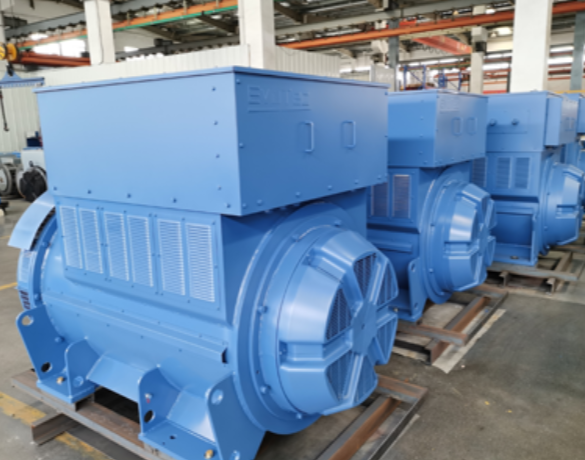
When a critical power plant or offshore platform loses generation capacity, the root cause is rarely a single part — it’s a chain of avoidable mistakes. This playbook starts with that problem: wrong specs, supplier shortcuts, and poor commissioning that turn a 4500 kVA purchase into months of downtime. If your scope includes a marine alternator, plan early for corrosion protection, cooling and AVR matching — these choices decide whether the set will live up to its rating. The Port of Rotterdam experience shows that ports and large marine projects demand predictable uptime; planning around that reality avoids last-minute scrambles.
Recognize the core problem
Most failures trace to mismatched expectations. A generator sized only for standby duty fails when it faces continuous prime loads. Alternator thermal limits, insufficient short-circuit withstand, and weak control logic (AVR and governor tuning) show up during peak demand. Frequency stability and synchronization missteps create cascading trips. Address these systematically rather than reacting to each symptom.
Sizing and specification checklist
Build a spec that engineers and procurement can both read. Key items:
– Duty type: continuous (prime) vs standby. Specify fuel consumption curves and ambient derating.
– Electrical: 4500 kVA at required power factor; short-circuit MVA; harmonic distortion limits.
– Mechanical: prime mover compatibility, cooling capacity, vibration isolation, and shaft alignment tolerances.
– Control: AVR type, governor droop settings, synchronization and load sharing capability.
– Environmental: marine-grade insulation, IP enclosures, and corrosive atmosphere coatings if near saltwater.
Sourcing: vendors, components, and procurement traps
Procurement often chases lowest price and then pays in lead-time and test failures. Favor vendors with documented factory acceptance tests and field references in similar environments; a genuine ship alternator supplier list matters when you need marine certification and spares. Verify supply chain transparency for rotors, stators and control modules — replacements that need months to fabricate are a huge operational risk.
Installation and commissioning essentials
Mounting and commissioning are where theory meets reality — poor baseplate alignment or undersized cooling ducts kill reliability. Use anti-vibration mounts sized for the generator’s mass and torque. Configure and tune the AVR and governor to the site’s inertia and transient profile. Perform synchronization tests under incremental loads and validate load sharing across paralleling sets. Small detail: label every cable and control loop during installation — it cuts troubleshooting time in half. —
Common mistakes and how to avoid them
Typical traps and fixes:
– Buying to kVA only: specify thermal cycles and overload capacity.
– Skipping FAT (factory acceptance test): insist on witnessed FAT with performance curves recorded.
– Ignoring harmonics: include passive or active filters when large nonlinear loads exist.
– Poor spare parts planning: stock critical spares like AVR modules and excitation brushes.
Operational teardown and validation
Run structured validation: cold-starts, hot-starts, load-bank runs to 100% and beyond for short intervals, thermal-imaging scans of stator connections, and harmonic spectrum analysis under representative loads. Document synchronization windows and transient response. During the operational production teardown we logged {main_keyword} against baseline expectations and measured {variation_keyword} during step-load changes to confirm governor response and AVR stability. Use a calibrated load bank and SCADA logs to prove performance before handover.
Advisory: Three golden rules for selection and deployment
1) Prioritize demonstrated reliability over lowest initial cost — metrics: MTBF, field failure rate, and FAT pass rate.
2) Verify service coverage and spare parts lead times — minimum: local technician availability within 48–72 hours and parts delivery windows documented.
3) Require full commissioning deliverables: signed FAT reports, control logic diagrams, and a 72-hour continuous run with recorded telemetry proving frequency and voltage stability under load changes.
Final word: specify clearly, test completely, and accept only measured performance — that’s how you turn procurement into resilience. EvoTec. —
